
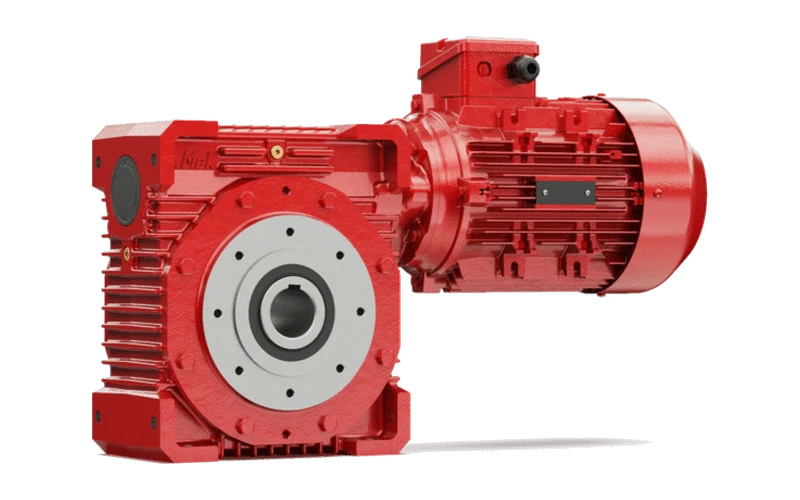
A helical vs worm gearbox comparison should consider output torque and speed, operating hours, shaft layout, thermal capacity and total cost. The best choice depends on the duty and the ratings of the actual units being compared.
Both are proven designs, and I-MAK makes both. This guide sets them side by side, with a worked example of the running costs and a quick way to choose.
How each type works
Helical gearboxes
Helical gears have teeth cut at an angle, so each pair of teeth meshes gradually rather than all at once. Contact includes both rolling and sliding. Helical gearing generally has lower tooth-friction losses than worm gearing, while gradual engagement supports smooth running.
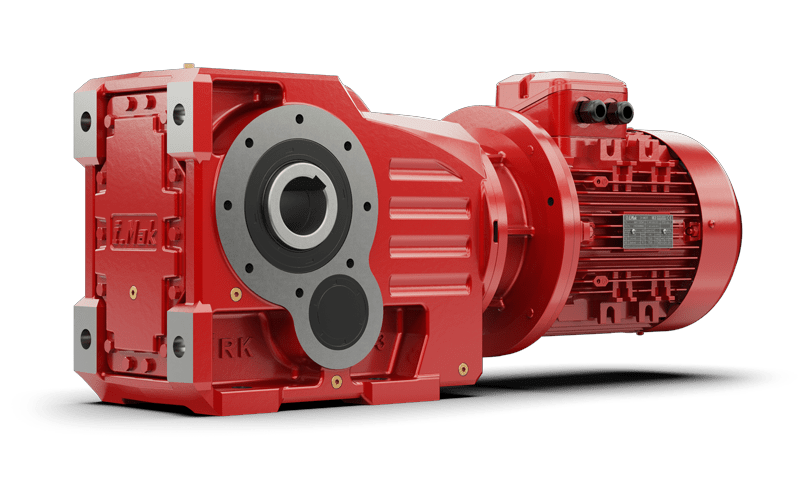
Each helical stage gives a modest reduction, so a helical gearbox uses two, three or four stages for higher ratios. The output can sit in line with the motor, as in the I-MAK IR series, parallel to it, as in the YP series, or at a right angle with a bevel stage, as in the IRK helical bevel series.
Worm gearboxes
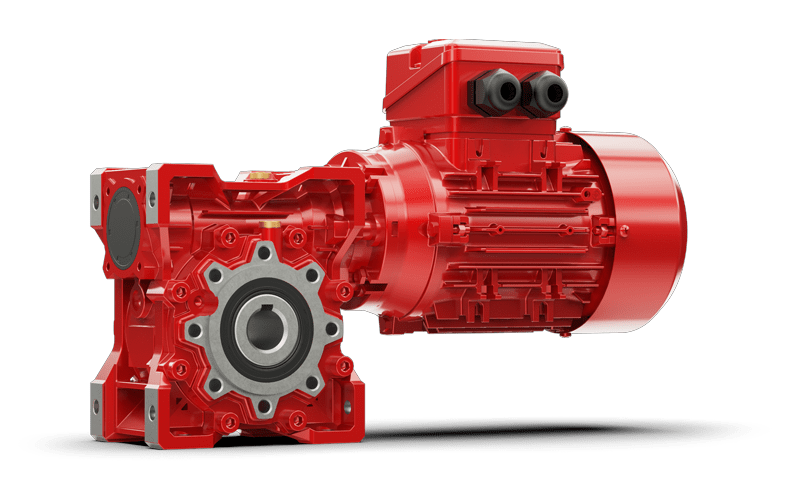
A worm gearbox uses a threaded shaft, the worm, to turn a worm wheel set at 90 degrees to it. One worm stage gives a high ratio, so the output turns slowly from a standard motor in a compact housing.
Worm gearing has a high proportion of sliding contact, which contributes to friction losses and heat. I-MAK’s worm ranges are the compact S series, the cast iron IRS series and the IRSD helical worm series.
Helical vs worm gearbox: side by side
| Item | Helical, including helical bevel | Worm |
|---|---|---|
| Shaft layout | Inline, parallel or right angle | Always right angle |
| Ratio from one stage | Modest, so two to four stages for high ratios | High: up to 100:1 (S) or 115:1 (IRS) |
| Efficiency | Generally higher; confirm the complete unit at the required speed, load and ratio | Depends on ratio, input speed, load and lubrication; use the selected unit’s catalogue data |
| Heat | Usually lower losses, but thermal capacity still needs checking | More of the input becomes heat, especially at high ratios |
| Torque in I-MAK’s ranges | Up to 18,000 Nm (IR, IRK and YP) | Up to 1,554 Nm (S), 6,000 Nm (IRSD) and 10,562 Nm (IRS) |
| Size and price | Larger and dearer at low power and high ratios | Compact and economical, especially at low power |
| Holding a load | Assess reverse motion and the required braking or holding system | Do not rely on self-locking as a holding or safety function |
Worm torque figures are range data at 1,400 rpm input, from the I-MAK S, IRS and IRSD catalogue, 2025; helical figures are from the IR, IRK and YP range pages.
Efficiency and running costs
Compare efficiency at the same output torque and speed. Ratio, input speed, load, lubrication and running-in conditions can affect the result, particularly for worm drives. A catalogue maximum or a generic percentage is not enough to predict an actual electricity bill.
For an illustrative energy comparison, assume 3 kW of mechanical output for 16 hours a day, 250 days a year: 4,000 running hours. Assume gearbox efficiencies of 65% and 93%, and motor efficiency of 90% in both cases. These are calculation assumptions, not quoted I-MAK performance or selected motor ratings. Control and other system losses are excluded.
| Item | Worm gearbox | Helical bevel gearbox |
|---|---|---|
| Efficiency assumed | 65% | 93% |
| Power at the gearbox input | 4.62 kW | 3.23 kW |
| Assumed motor efficiency | 90% | 90% |
| Calculated electrical input | 5.13 kW | 3.58 kW |
| Calculated annual electricity use | About 20,513 kWh | About 14,337 kWh |
Electrical input in this example is output power divided by gearbox efficiency and motor efficiency: 3 ÷ (0.65 × 0.90), or 3 ÷ (0.93 × 0.90). Using unrounded values gives an annual difference of approximately 6,176 kWh. At an assumed tariff of 25p per kWh, that is approximately £1,544 per year. Use actual operating hours, load-dependent efficiencies and your tariff for a project comparison. Motor size, starting duty and gearbox thermal capacity must be checked separately.
Compare the calculated energy saving with the complete installed-price difference to assess payback. At low power or short operating hours, purchase and installation costs may outweigh the energy saving; no payback period can be stated without those figures.
Holding a load: the self-locking myth
Worm gearboxes are often described as self-locking. Some high-ratio worm sets do resist being turned back from the output, but that depends on the worm’s lead angle, wear, lubrication and vibration. It is not something to rely on.
For an inclined conveyor, a correctly selected backstop may prevent reverse rotation in one direction. It does not provide controlled stopping or lowering. Lifting and load-holding machinery needs a braking arrangement designed for the complete load path and duty; adding a motor brake alone does not establish that suitability. Confirm the options and limits for the exact I-MAK unit.
When to choose a worm gearbox
A worm gearbox is usually the better choice when:
- the power is low and the hours are modest, so energy costs matter less than the purchase price;
- you need a high ratio in a small space, with up to 100:1 from the S and 115:1 from the IRS in a single housing;
- the drive must turn through 90 degrees in a compact unit, with a hollow output shaft as standard;
- you need very low output speeds, with up to 499:1 from one IRSD housing, or 5,000:1 with two worm units combined.
Choose the S for small drives from 13 to 1,554 Nm and 0.12 to 15 kW, and the IRS for cast iron strength up to 10,562 Nm and 22 kW. Our guide to worm gearboxes goes into more detail.
When to choose a helical gearbox
A helical gearbox is usually the better choice when:
- the drive runs for long hours, so efficiency turns into real savings;
- the power and torque are higher, up to 18,000 Nm, with motors to 160 kW on the IR and 200 kW on the IRK and YP;
- the duty is heavy, as the IR and IRK use 16MnCr5 steel gears, hardened to 57 HRC and ground;
- the motor can sit in line with or parallel to the driven shaft.
Choose the IR for an inline drive and the YP for a compact parallel shaft unit with a hollow output. Our guide to helical gearboxes covers the IR in more detail.
The middle ground: helical bevel and helical worm
Two designs combine the strengths of both:
- Helical bevel (IRK). A right-angle drive like a worm, with the efficiency of bevel and helical gearing. It has a hollow output shaft as standard, ratios from 4:1 to 21,000:1, and ratings up to 18,000 Nm. Read our guide to bevel helical gearboxes.
- Helical worm (IRSD). A helical stage ahead of the worm reaches ratios from 15:1 to 499:1 in one housing, for output speeds down to 2.81 rpm from a 1,400 rpm motor. Read our guide to helical worm gearboxes.
For many conveyor and process drives that need a right angle and run all day, the helical bevel is where the decision lands.
A quick way to choose
- Does the drive need to turn through 90 degrees? If not, look at the IR (inline) or YP (parallel shaft).
- Will it run for long hours or dissipate substantial heat at the required ratio? If so, compare the IRK helical bevel on efficiency, thermal capacity and installed cost. There is no universal power threshold.
- Is it a smaller, lighter duty that needs a high ratio in a compact unit? Then the S, IRS or IRSD worm ranges are likely the best value.
Whichever you choose, size it with the right gearbox service factor for your duty.
Not sure which suits your machine?
Advanced Drives is the official UK supplier of I-MAK gearboxes, geared motors and motors, based in Silsden, West Yorkshire. Send us the torque, output speed, hours a day and the layout you need, and we will recommend an I-MAK unit and show you the running cost comparison. Contact our team, or use I-MAK’s iGuide configurator.
Replacing an existing worm gearbox? Send us the nameplate, and we will check whether a worm or a helical bevel unit fits your mounting. See our replacement gearboxes page.
Helical vs worm gearbox FAQs
Is a helical gearbox more efficient than a worm gearbox?
Helical and helical-bevel units generally have lower tooth-friction losses, but compare complete units at the required load, speed and ratio. Use actual gearbox and motor efficiencies to estimate electricity use.
Are worm gearboxes self-locking?
Do not use self-locking as the holding or safety function. Resistance to back-driving varies with design and operating conditions. A backstop prevents reverse rotation in one direction; a lifting drive needs an appropriate braking and control arrangement for the complete machine.
Which is quieter?
Both run quietly when correctly sized. I-MAK lists low noise and low vibration among the strengths of the S series, and grinds the gears of the IR for quiet running.
Can I replace a worm gearbox with a helical bevel gearbox?
It may be possible. Check torque and speed, shaft and mounting dimensions, thermal capacity, motor starting duty and controls. If the original drive was relied on to hold a load, review the complete braking arrangement before replacement. Send us the nameplate and machine details so we can assess the options.
Which lasts longer?
Service life depends on sizing, duty, temperature, lubrication, installation and maintenance. The higher sliding losses of worm gearing can make thermal checks particularly important on continuous duty. Neither gear type alone establishes how long the drive will last.
What is a helical worm gearbox?
A gearbox with a helical stage ahead of the worm stage. The I-MAK IRSD uses this layout to reach ratios up to 499:1 from one housing.