

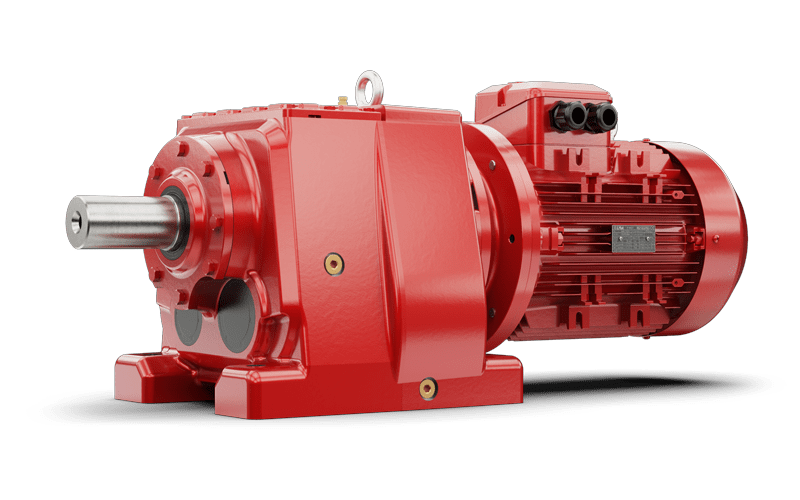
An inline helical gearbox reduces motor speed and increases torque while keeping the input and output shafts on the same axis. A geared motor combines the gearbox and motor in one drive assembly. The I-MAK IR Series is an inline range used for conveyors, mixers, pumps and packaging machinery.
This guide explains the layout, what to check when selecting a unit, and when a parallel shaft or right-angle drive may suit the machine better. For dimensions, motor options and downloads, see the I-MAK IR inline helical geared motor range.
What is the difference between helical and inline?
Helical describes the angled gear teeth. Their gradual engagement supports smooth power transmission. Inline describes the shaft arrangement. Helical gearing also appears in parallel shaft and helical bevel units, so the terms are not interchangeable.
An inline layout is useful when the motor can sit behind the driven shaft. Check the complete assembly length, shaft height and access for maintenance before choosing it. If space beside or behind the machine is restricted, compare the alternatives below.
Efficiency, noise and service life depend on the selected unit and its operating conditions. Smooth gear engagement does not remove shock loads from the machine or replace checks for starting torque, overloads and thermal capacity.
I-MAK IR Series inline helical geared motors
Advanced Drives supplies the IR Series with a rigid unicase housing and hardened, precision-machined gearing. I-MAK lists foot, flange and combined foot-and-flange arrangements, with gearbox-only, motor and IEC motor-adaptor configurations.
The range includes units with maximum torque ratings up to 18,000 Nm and applicable motor powers from 0.12 to 160 kW. These are range limits, not ratings available in every size, ratio or mounting arrangement. Use the selection data for the exact configuration.
Our IR Series product page provides the size tables and catalogue links. The manufacturer’s IR Series overview describes the available configurations.
How to select an inline gearbox and motor
- Establish output speed and torque. Include normal running, starting and peak loads. Ratio follows from input speed divided by required output speed; motor power alone does not define a suitable gearbox.
- Describe the duty. Include hours per day, starts per hour, reversing, load variation and any jams. Check the required service factor and thermal capacity for that duty.
- Confirm the mechanical interfaces. Check shaft diameter and keyway, foot or flange dimensions, coupling, shaft height and available space. Radial and axial loads need their own bearing checks.
- Specify the mounting position. Orientation affects the lubrication arrangement. Use the exact unit’s mounting drawing and oil instructions; our gearbox mounting guide explains what to record.
- Match the motor and controls. Include supply voltage, speed range, starting method and any brake or feedback requirements. For variable speed operation, see our VFD and gearbox selection guide.
- Record the environment. Dust, water, cleaning chemicals, ambient temperature and any hazardous-area classification affect the final specification.
Inline, parallel shaft or right-angle gearbox?
- Inline helical, IR: a starting point when the motor and driven shaft can share an axis. Typical applications include conveyors, mixers, pumps and packaging machinery.
- Parallel shaft, YP: compare this layout when an offset motor position or hollow output shaft helps the installation. See the YP parallel shaft range.
- Right-angle helical bevel, IRK: compare this layout when the drive needs to turn through 90 degrees. See the IRK helical bevel range.
Choose the layout before comparing sizes. A different gearbox type is not automatically interchangeable, even when its nominal ratio and motor power match.
Illustrative example: assessing a bottling-line drive
For a bottling line considering replacement of a worm geared motor with an IR inline helical unit, begin with required speed, running torque, start frequency and available space. Compare the proposed unit’s efficiency and thermal rating at the operating duty, and confirm the mounting and shaft interfaces.
If the machine indexes bottles, establish positioning accuracy, feedback and stopping requirements with the controls designer. An encoder and inverter are components of that system, not a guarantee of accurate indexing. Assess cleaning and environmental requirements alongside the mechanical selection.
This is an illustrative selection example, not a reported beverage-producer project. Noise, energy use, spillage and maintenance outcomes require evidence from the actual installation.
Replacing an existing inline geared motor
Send the nameplate, photos and mounting dimensions, together with the required output speed and details of what the machine does. Confirm the shaft and flange interfaces, direction of rotation, supply and duty before treating a replacement as suitable.
For an initial assessment, contact Advanced Drives or read about our replacement gearbox service. If the drive operates on a food line, include the cleaning regime and temperature; our food and beverage gearbox page sets out the options to discuss.