
A planetary vs helical gearbox comparison is useful when it starts with the machine: its output speed, operating torque, load pattern and available space. Neither description, on its own, identifies the best gearbox for the job. The decision needs a comparison of complete, suitable configurations.
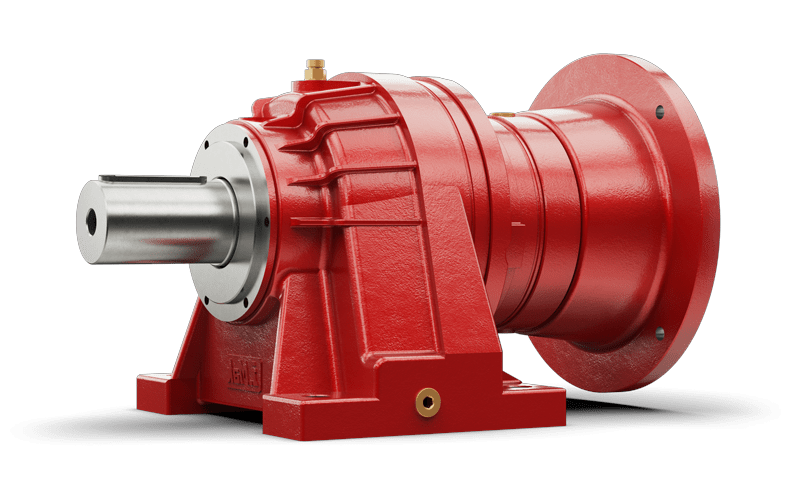
Here, planetary describes an arrangement of gears, while helical describes a tooth form. They are not mutually exclusive terms: planetary gears can also have helical teeth. In this guide, the practical comparison is between industrial planetary units and the fixed-axis helical arrangements commonly offered for industrial drives.
Start with the required shaft arrangement
Sketch where the motor can sit and where the driven shaft must be. Include the full assembly, any coupling and the space needed to remove components. An inline layout and a right-angle layout solve different packaging problems; neither should be selected from a photograph alone.
I-MAK positions its IPR/IPRK planetary range for high-torque duties where space is restricted. Its IR helical range is another starting point for an inline industrial drive. Larger industrial arrangements can also be explored through the A/AE range. These are routes into selection, not interchangeable units.
| Requirement | What to compare |
|---|---|
| Output duty | Required speed and torque, including loaded starts, peaks, reversals and operating hours. |
| Installation envelope | Complete drive dimensions, motor position, shaft arrangement and access for removal. |
| Connection to the machine | Shaft or bore details, coupling, mounting, torque reaction and external shaft loads. |
| Heat and environment | Thermal capacity for the actual installation, lubricant requirements, ambient conditions and cooling arrangements. |
| Maintenance | Access to inspection points, oil service, motor replacement and the driven-machine connection. |
Compare ratings on the same basis
A range headline may describe the largest unit or a maximum rating. It does not establish the rating of the particular size, ratio and input arrangement being considered. Ask for the proposed unit’s applicable operating and peak limits, together with the assumptions used for the duty assessment.
Keep the required service factor separate from a general claim that one gearbox type is stronger. The manufacturer’s selection method must cover the machine’s load pattern. A steady conveyor, a reversing mechanism and a machine with impact loads should not be treated as identical simply because their normal output torque is the same.
Treat efficiency and cost as application questions
Request efficiency information for the proposed configuration and operating point before comparing energy use. Include the motor and control system when the question is electrical consumption. A gearbox-only efficiency figure is not the efficiency of the whole drive, and a percentage from a different ratio or duty may not support the comparison.
Likewise, compare the installed arrangement rather than the gearbox price alone. Ask whether the quoted scope includes the motor, mounting parts, coupling, cooling equipment and drawings. Record anything that would require a change to the machine so it can be assessed before ordering.
Build a shortlist that can be checked
- State the required output speed and continuous torque, and identify where those values came from.
- Describe the highest expected load, how long it lasts and how often it occurs.
- Attach a layout sketch with the available envelope and shaft positions.
- Identify environmental and installation requirements that must be met.
- Request a configuration-specific rating and drawing for each shortlisted solution.
For a new machine, start with the I-MAK product range and send the duty details to Advanced Drives. For a replacement, include the existing nameplate and installation photographs. A useful comparison ends with a documented match to the duty, rather than a universal winner between gearbox types.
Technical references
For the exact unit, use its confirmed drawing, applicable catalogue and operating instructions. The following references support the principles discussed here: