
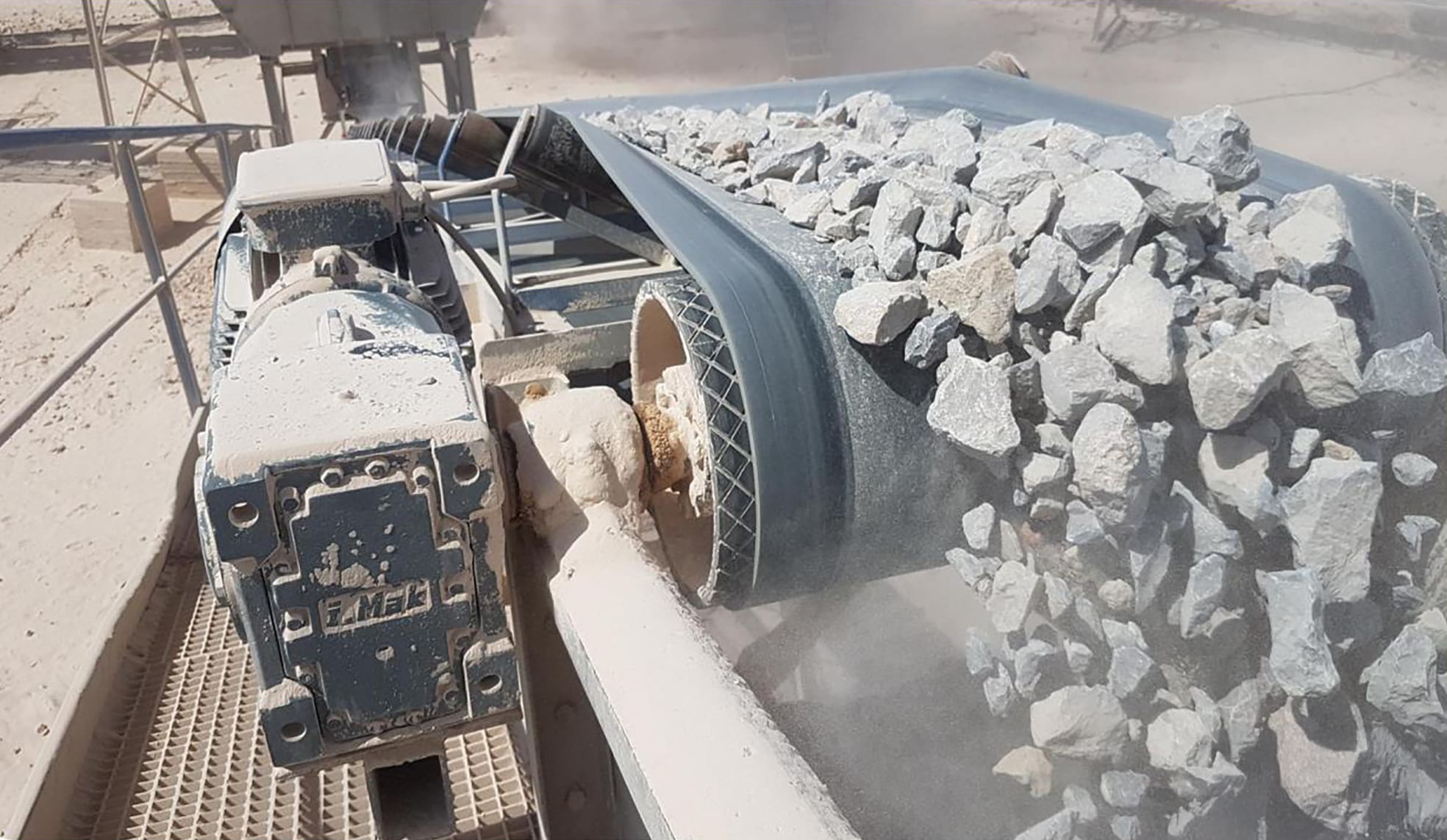
The gearbox service factor helps match a gearbox rating to the way a machine operates. It accounts for duty within the manufacturer’s selection method. It is not a guarantee of service life, and it does not replace checks for peak torque, heat, shaft loads or overload protection.
This guide explains what the service factor is, how to choose the right one for your duty, and how to use it with I-MAK’s catalogue tables.

What is a gearbox service factor?
A service factor, written Sf or fs, is used in the manufacturer’s sizing method. Distinguish the factor required by the application from the factor available in a proposed gearbox or geared motor selection. A common torque-based expression is:
Available service factor = applicable gearbox torque rating ÷ operating output torque
For illustration, a gearbox with an applicable rating of 1,500 Nm and an operating output torque of 1,000 Nm has an available factor of 1.5. If the manufacturer’s method requires 1.5 for the duty, the mechanical rating check is satisfied at that operating point. The rating must apply to the actual size, ratio, speed and configuration.
Use the performance tables for the actual range, such as the IR helical geared motor, IRK helical bevel or YP parallel shaft. A range maximum is not the rating of every ratio or motor combination. Service-factor definitions can also differ between manufacturers.
Why a gearbox needs a margin
Catalogue ratings have defined operating conditions. Check how the actual duty differs:
- Uneven loads. A crusher or shredder hits the gearbox with shocks that a belt conveyor rarely does.
- Long hours. Gear teeth and bearings fail through fatigue, which builds with every revolution. A drive running 24 hours a day does three times the work of one running eight.
- Starts and stops. Starting and acceleration can produce loads above steady running, especially with high inertia or a loaded restart.
- Peaks and jams. Blockages can create abnormal torque. Check permitted peak loads and suitable protection separately.
A suitable service factor helps the mechanical selection account for duty. Lubrication, alignment, temperature, contamination and maintenance also affect life, so a larger factor alone does not predict how many years a gearbox will last.
How to choose the right service factor
Start with the driven machine’s load pattern and total daily operating hours, then check starting frequency, inertia, reversals and unusual conditions. The following IR catalogue example shows how load class and running hours affect the required factor; use the applicable current catalogue and confirm the classification for your actual machine.
Step 1: find the load class
I-MAK sorts driven machines into three load classes. These examples come from its own list:
| Load class | Typical machines |
|---|---|
| Uniform (U) | Belt conveyors carrying bulk goods, bucket elevators for flour-like goods, filling and packaging machines, agitators for liquids, axial and radial fans |
| Moderate (M) | Belt conveyors carrying piece goods, screw and apron conveyors, mixers, pumps, kneading machines |
| Heavy (H) | Crushers, hammer and ball mills, rubber extruders and calenders, inclined hoists, crane hoist gears, rotary drilling equipment |
Step 2: read the service factor from the table
The linked I-MAK IR catalogue gives the following factors for electric-motor drives. This is a range-specific table, not a universal rule for all gearboxes:
| Hours a day | Uniform (U) | Moderate (M) | Heavy (H) |
|---|---|---|---|
| Up to 3 | 0.8 | 1.0 | 1.5 |
| 3 to 10 | 1.0 | 1.25 | 1.75 |
| 10 to 24 | 1.25 | 1.5 | 2.0 |
Source: I-MAK IR series catalogue, load-characteristics and service-factor table. Confirm the applicable catalogue revision for supply. Engine-driven equipment has separate selection values.
Step 3: allow for anything unusual
The table alone does not complete the selection. Give us the starts per hour, acceleration time, load inertia and reversing pattern. The following conditions may need additional checks with I-MAK:
- frequent starts under load, or reversing;
- heavy shock or regular jams;
- high ambient temperatures, which we also check against the thermal limit;
- loaded starts, braking or jams that could exceed the gearbox’s permitted peak torque.
Worked examples
These illustrative calculations assume two machines each need 1,200 Nm of operating torque at the gearbox output. The stated load classes must be confirmed against the real duty.
| Item | Bulk belt conveyor | Crusher drive |
|---|---|---|
| Torque needed | 1,200 Nm | 1,200 Nm |
| Load class | Uniform | Heavy |
| Hours a day | 16 | 24 |
| Service factor | 1.25 | 2.0 |
| Rating needed | 1,500 Nm | 2,400 Nm |
With an assumed required factor of 1.25, the conveyor’s reference torque requirement is 1,200 × 1.25 = 1,500 Nm. With a factor of 2.0, the crusher’s requirement is 1,200 × 2.0 = 2,400 Nm.
These figures do not identify a final IR or IRK housing size. Check the selected unit’s rating at the required ratio and speed, together with peak torque, thermal capacity, shaft loads and the proposed motor. A catalogue range maximum is insufficient for that decision.
For the torque figure itself, our guide to calculating conveyor torque walks through the sums.
Using the service factor in I-MAK’s geared motor tables
For geared motors, the performance table identifies a particular combination of motor power, ratio and output speed. Use the service factor shown for that combination and the catalogue’s definition of its output torque. If a larger motor can apply more torque than the machine normally needs, account for that when checking the drive and protection.
- Establish the required output speed, running torque and starting duty, then check the proposed motor and ratio.
- Pick a line whose service factor is at least the figure for your duty.
- If the selection does not meet the duty, compare another size or arrangement and repeat the mechanical and thermal checks.
Not every range uses a single factor
Some I-MAK ranges build the duty into the selection in other ways:
- IRNX shaft mounted gearboxes list the maximum motor power for light, moderate and heavy loads at 8, 16 and 24 hours a day.
- IPR and IPRK planetary gearboxes use planetary-range selection data that account for output speed and required operating life. Follow that method rather than transferring an IR factor to the planetary range.
- IRC hoist drives are selected from the load, drum and lifting speed, and the crane duty class, from ISO M3 to M8 (FEM 1Bm to 5m).
Service factor and heat are separate checks
The service factor covers strength and life. Heat is a separate limit: a gearbox can be strong enough and still run too hot on long, high-power duty.
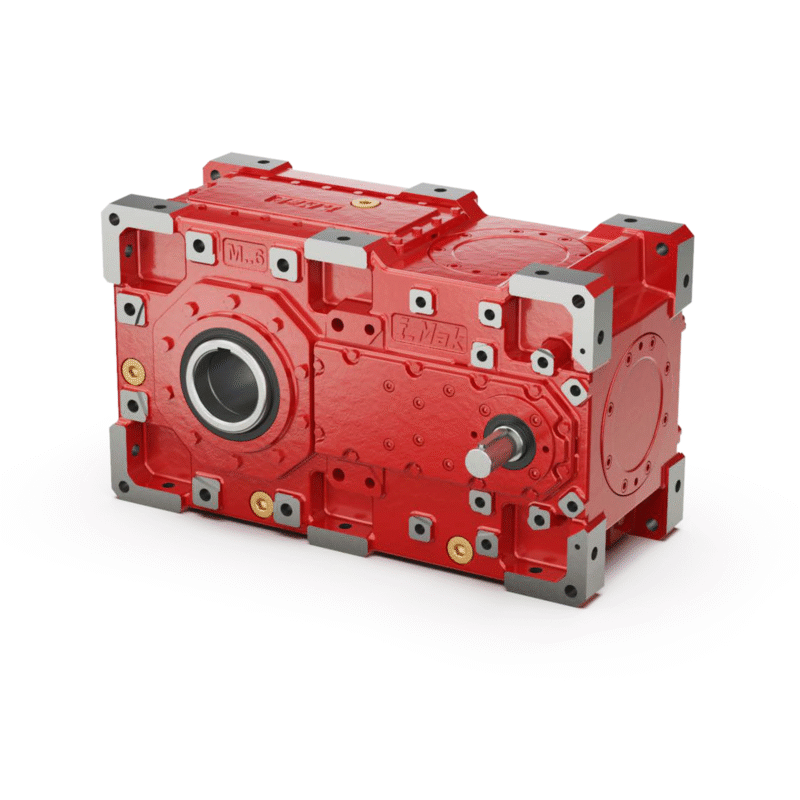
I-MAK publishes thermal ratings for every MA and MK monobloc gear unit, with and without cooling, and a thermal power for each IPR planetary size. Worm gearboxes need particular care, because more of their input power turns into heat. Tell us the power, hours and ambient temperature, and we check both.
Common sizing mistakes
- Counting hours per shift, not per day. Two eight-hour shifts put a drive in the 10 to 24 hour band.
- Stacking margins. A generous torque estimate plus a high service factor can leave you with a gearbox twice the size you need.
- Forgetting stalls. If the machine can jam, check the motor and control system’s possible peak torque, the gearbox’s permitted overload and the response of any protection.
- Ignoring radial load. A chain sprocket or belt pulley on the output shaft adds an overhung load, which has its own limit in I-MAK’s tables.
For more on protecting a drive from overloads, read our guide to gearbox overload protection.
Need a hand sizing a gearbox?
Advanced Drives is the official UK supplier of I-MAK gearboxes, geared motors and motors, based in Silsden, West Yorkshire. Send us the torque, or the power and speed, with the hours a day, starts per hour and what the gearbox drives. We will select an I-MAK unit and send you the figures. Contact our team, or try I-MAK’s iGuide configurator.
Replacing an existing gearbox? Send the nameplate along with the required duty, shaft dimensions and mounting details. See our replacement gearboxes page.
Gearbox service factor FAQs
What service factor should I use?
Use the selected range’s method, starting with load class, total daily hours and starting pattern. The IR table above illustrates values from 0.8 to 2.0 for its stated electric-drive conditions; it should not be applied unchanged to other ranges or unusual duties.
Can a service factor be less than 1?
Some manufacturer tables include values below 1 for defined short-duration duties. That is not general permission to exceed a gearbox’s permitted torque. Confirm the applicable rating method, peak limits and complete operating cycle with the manufacturer.
Is a higher service factor always better?
Not necessarily. Choose the margin required by the manufacturer’s method and the actual duty. Extra size can increase cost and installation demands, while heat, contamination or poor alignment can still limit service life.
Can I compare service factors across manufacturers?
Not without checking the definitions and applicable standard. A service class or factor from one catalogue is not automatically equivalent to a similarly labelled value from another. Compare the required duty and the complete selection method.
Does a motor have a service factor too?
Some motor nameplates include a motor service factor. It describes the motor under specified conditions and is separate from gearbox selection. Do not use a motor factor to justify extra gearbox load; check the motor data and gearbox limits independently.
How do I find the service factor of an existing gearbox?
Identify the exact gearbox, ratio, speed and motor combination, then check the manufacturer’s applicable rating and service-factor method against the real duty. Send us the nameplate details, operating loads, hours and starts per hour.