
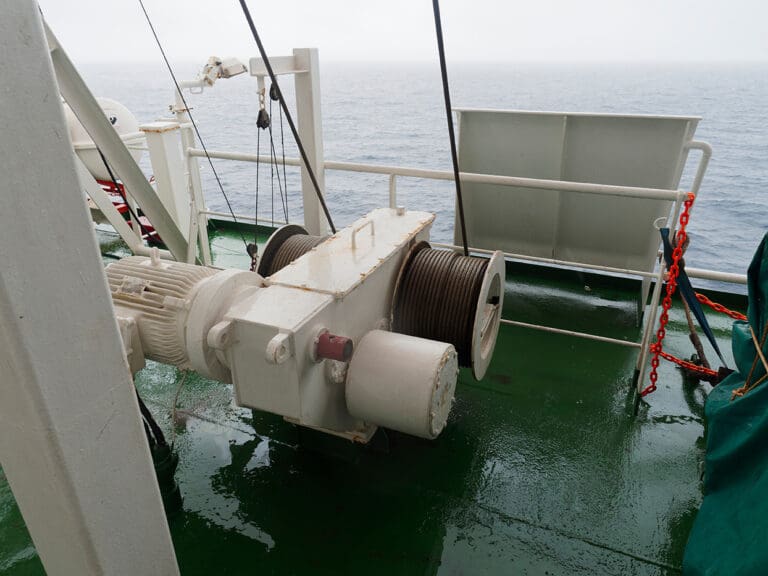
Hoist and winch gearboxes turn a motor’s speed into the slow, high torque needed to wind rope onto a drum. They carry the full load torque, cope with frequent starts and stops, and pass the brake’s holding torque to the drum. This guide covers what matters when choosing a lifting drive, and where the I-MAK IRC, YP and IRK ranges fit.
What hoist and winch gearboxes have to do
Lifting is safety critical, so the drive is chosen for the load and duty, not just the motor power.
High torque at the drum
Drum torque depends on rope tension and the working drum radius, with the reeving arrangement and its losses also considered. Check the relevant rope layers: the same line pull requires more torque as the effective drum radius increases. The drum, rope and gearbox therefore need to be selected together.
Shock loads and frequent starts
Loaded starts, stopping and slack-rope take-up can create peak loads. Hoist mechanism class reflects operating time and load history. An appropriately selected drive and control arrangement can manage acceleration and deceleration, but a VFD does not by itself establish acceptable peak loads or accurate hook positioning.
Holding the load
A helical gearbox can be back driven, so it does not hold a load on its own. The brake and the system design hold the load. Hoist brakes normally apply when power is removed, and the gearbox must be strong enough to carry the brake’s holding torque to the drum, so the two are selected together. The complete hoist or crane must be designed, tested and certified to the relevant standard, such as BS EN 14492 for power driven winches and hoists, and examined in service as LOLER requires.
The I-MAK IRC: a dedicated hoist drum drive
The IRC Series is I-MAK’s geared motor for crane hoisting drums, designed for hoist and winch applications.
Construction
- A monobloc GG22 cast iron housing with three helical gear stages, which gives the high reduction a hoist needs.
- Gears in hardened case carburising steel, and tapered roller bearings with a long bearing span for high radial loads.
- A splined output shaft to DIN 5480 with a drum connection flange, so the unit connects directly to the drum.
- A wide centre distance between input and output, which allows larger drums for longer rope life.
The range at a glance
| Sizes | Seven, IRC 63 to IRC 143 |
| Lifting capacity | 0.5 t to 75 t |
| Output torque | Up to 29,771 Nm in I-MAK’s hoisting tables |
| Motors | 0.18 kW to 90 kW |
| Ratios | 24:1 to 201:1 |
| Drum diameter | 100 mm to 500 mm |
| Reeving | 1/1 to 8/1 falls |
| Versions | IRC (input shaft), IRCM (with motor), IRCP and IRCPM (IEC input flange, without or with motor) |
How an IRC is selected
I-MAK’s selection tables are organised by load, falls, drum diameter, lifting speed and ISO/FEM mechanism class. Selection by mechanism class is not interchangeable with applying a generic service factor. If the duty class is unknown, provide the operating hours, cycles, hook travel and load history for assessment.
Brake and motor options
Brakes are options chosen for each application: a single or double brake, each with or without hand release, at 24 V DC or 220 V AC. Other options include an encoder, backstop, external fan, canopy, motor thermal protection and an oil temperature sensor. For outdoor cranes, corrosion protection paint systems to EN 12944 categories C2 to C5 are available.
YP for hoist and crane travel drives
On a crane, travel drives move the bridge along the runway and the trolley across the bridge. The YP Series parallel shaft helical geared motor suits this work: I-MAK’s catalogue names it for conveyors, hoist drives and crane travel drives. It has a hollow output shaft as standard, with solid shaft, flange and shrink disc options, and rubber mounting rings that act as a torque arm and absorb shock at start up. Ten housing sizes cover 130 to 18,000 Nm, with motors from 0.12 kW to 200 kW and the same brake, encoder and backstop options.
IRK for stage machinery
The IRK Series is I-MAK’s helical bevel, right angle range: ten housing sizes, 160 to 18,000 Nm and motors from 0.12 kW to 200 kW. I-MAK names the IRK for theatre stage machinery, where quiet, precise motion matters, and pairs it with double brakes, hand release, an encoder and microswitch feedback. A right angle drive also helps where space is tight.
Common applications for hoist and winch gearboxes
- Overhead and gantry cranes: the IRC drives the hoist drum that raises and lowers the hook, and the YP can drive the travel motions.
- Industrial winches: winches that haul and hold heavy cables, such as on pulling and tensioning equipment.
- Material hoists: construction and goods hoists that lift materials only; tell us the duty and we will check the selection.
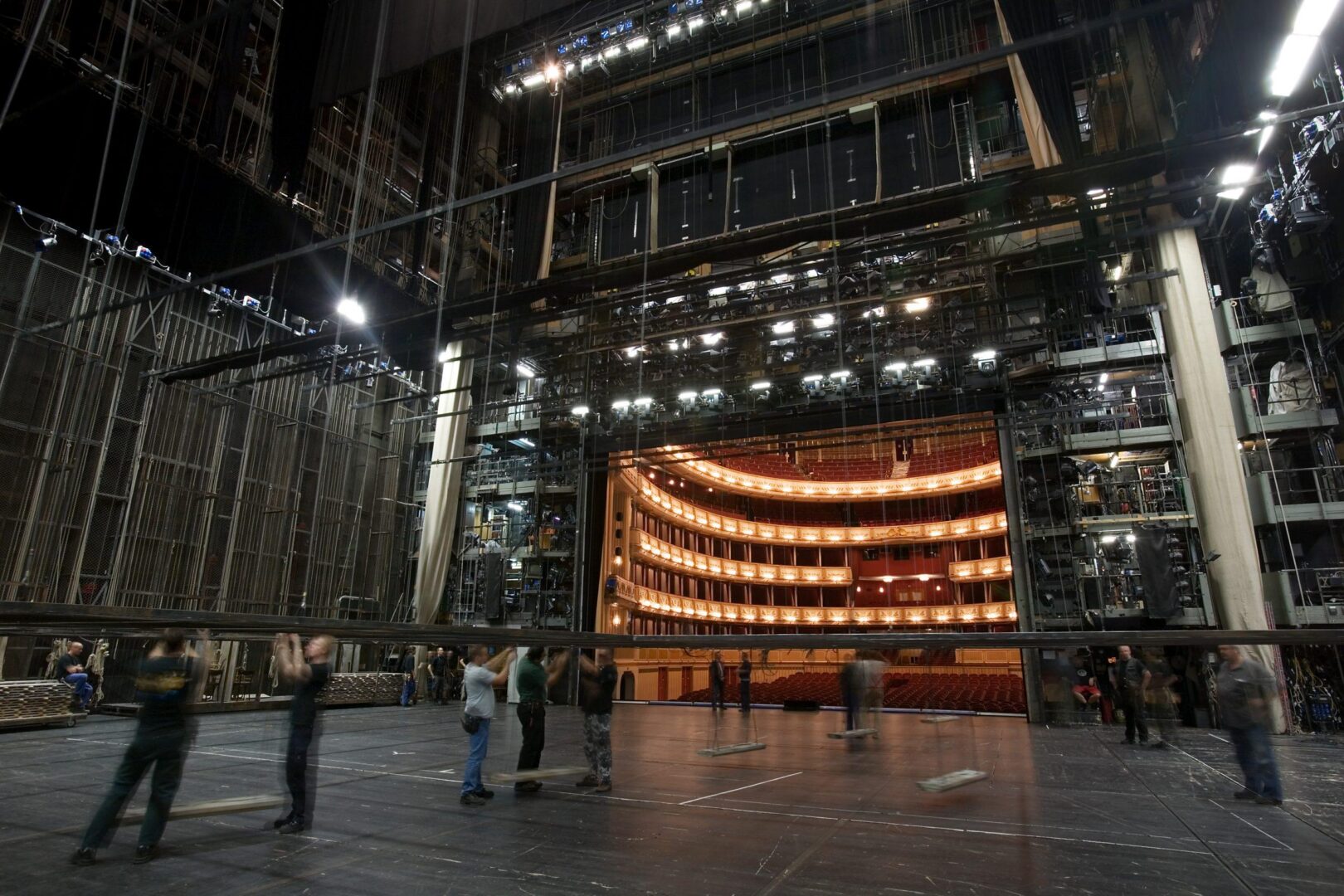
- Stage and theatre machinery: scenery and lighting hoists that need quiet, smooth and repeatable movement. See our theatre and stage machinery page.
Example: replacing a scenery hoist drive
This hypothetical example shows how we work; it is not a real project.
A theatre wants to replace a worn drive on a scenery hoist that winds wire rope onto a drum. We would ask for the load, falls, drum diameter, lifting speed, duty, space available and controls. From those, we could select an IRC size from I-MAK’s hoisting tables, or an IRK right angle geared motor if the layout needs it, with a double brake, hand release and an encoder for positioning. The brakes hold the scenery when the motor stops; the controls, safety devices, testing and certification stay with the system designer and the venue.
Looking after hoist and winch gearboxes
- Check the oil level, the vent plug and the fixing bolts regularly.
- For the IRC, I-MAK advises changing the oil after the first 500 hours, then every 6,000 hours.
- Inspect and adjust the brake as its instructions require, and keep examination records up to date.
Frequently asked questions
Does the gearbox hold the load when the motor stops?
No. A helical gearbox such as the IRC can be back driven. The brake holds the load, and the gearbox carries the brake torque to the drum. The whole hoist must be designed and certified to the relevant standard.
Is the IRC a bevel helical gearbox?
No. It has three helical stages in a monobloc cast iron housing, with a splined output to the drum. For a right angle drive, look at the IRK helical bevel range.
Can the IRC drive crane travel motions?
I-MAK’s IRC tables cover hoisting only. For crane travel drives, I-MAK names the YP parallel shaft range, and we will confirm the size.
What do you need from me for a quote?
The load, falls, drum diameter, lifting speed, mechanism class or duty, supply voltage, drive type (AC motor, AC motor with inverter or DC motor) and mounting position, plus any brake or encoder needs.
Talk to Advanced Drives
Advanced Drives is the official UK supplier of I-MAK gearboxes, geared motors and motors, based in Silsden, West Yorkshire. Send us your hoist or winch details through our contact page and we will help you specify hoist and winch gearboxes from the IRC, YP or IRK ranges to suit your lifting duty.