
Conveyors, crushers, mixers, mills and extruders put a gearbox under steady, heavy load for long shifts, often in dust and heat. For these duties you need an industrial gear unit that is sized correctly for the torque, the speed and the hours it will run. This guide explains what to look for in heavy duty industrial gearboxes and how the I-MAK industrial ranges supplied by Advanced Drives fit together.
What makes a gearbox heavy duty?
A heavy duty gearbox is not defined by size alone. It is a unit selected for the real demands of the machine, with enough margin for the way that machine is used.
Torque and shock loads
Start with the output torque the machine needs, then allow for starting loads and shocks. A service factor suited to the duty helps cover these peaks, so the gearbox is not running at its limit every day.
Continuous operation
Machines that run around the clock generate heat and wear. Bearings, seals and oil all need to suit long running hours, and the oil temperature should be watched.
Access for maintenance
A good heavy duty unit is easy to inspect and service. Oil checks, breather checks and planned oil changes keep it running between shutdowns.
The I-MAK A/AE Series: industrial helical gear units
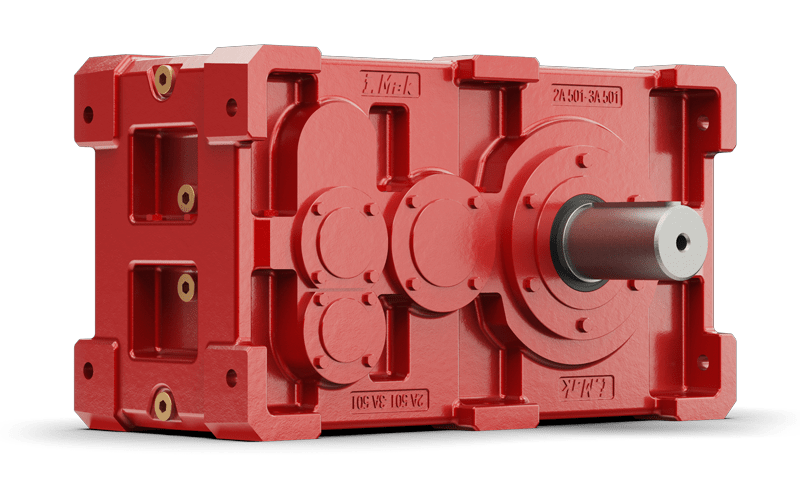
The I-MAK A/AE Series is a range of horizontal helical gear units built for heavy industrial duty. I-MAK designs the gears to help prevent noise and vibration during long, heavy operation.
Torque, power and ratios
- Maximum torque: 880 Nm to 33,000 Nm across eight housing sizes.
- Motor power: 0.37 kW to 160 kW, with the catalogue performance tables reaching 185 kW.
- Ratios: from about 1.7:1 to 487:1, across A, 2A, 3A and 4A types. The higher types add gear pairs for higher ratios.
- Output speed: 1.6 to 220 rpm for A types and 10 to 220 rpm for AE types.
A and AE versions
Both versions are helical, with no bevel stage. AE versions add an extruder bearing case for extruder drives, and share the performance tables of the A unit of the same size. AE units are offered in sizes 225 to 750.
Construction and lubrication
The units have a robust housing with a removable cover for inspecting the gears, and a solid output shaft. Oil quantities run from 4 litres on the smallest type to 65 litres on the largest. I-MAK lists mineral and synthetic gear oils, with the grade chosen to suit the operating temperature.
Options
- Oil temperature sensor, so that operating temperature can be monitored.
- Synthetic, food compatible or cold resistant (down to minus 40 °C) oils.
- Special, hardened or threaded output shafts, special input shafts and a connection coupling.
- Reinforced input or output bearings, and backstop bearings for clockwise or anticlockwise rotation.
- Special seals and covers, and epoxy, outdoor or anti-corrosion paint.
I-MAK lists no gearbox cooling options or thermal ratings for the A/AE Series. For hot or high power continuous duties, our engineers check the selection carefully and may suggest a different range.
When you need more than 33,000 Nm
I-MAK’s other industrial ranges take over where the A/AE Series stops.
- MA and MK Series: the monobloc industrial gear units, with a single piece cast iron housing in nine sizes, up to 70,000 Nm. MA is parallel shaft and MK is right angle. Unlike the A/AE, they list fan, cooling coil and heat exchanger cooling options, and pump forced lubrication.
- IPR and IPRK Series: planetary gearboxes, inline (IPR) or right angle (IPRK), in 20 sizes up to 743,990 Nm T2max, with electric or hydraulic motor input.
Typical uses for heavy duty industrial gearboxes
I-MAK does not name specific industries for the A/AE Series, so we select on the duty rather than the sector. Heavy duty gear units in general are used for:
- Mining and quarrying: crusher drives, feeders and conveyor head drives in dusty, nonstop conditions; see our mining and quarry gearboxes.
- Steel and metal processing: conveyors and mill auxiliary drives; see our gearboxes for steel and metal processing.
- Plastics and rubber: extruder drives, where the AE version carries the extruder bearing case.
- Materials handling and process plant: heavy mixers, pumps and screw drives, subject to torque and duty checks.
Example: replacing an ageing mill drive gearbox
This is a hypothetical example to show how a selection works. A plant has an older helical gearbox on a mill drive that runs continuously and runs hot in summer. The maintenance team wants a replacement that fits the existing foundation.
- The team sends us the nameplate details, the motor power and speed, the output speed, the duty and the shaft and foundation dimensions.
- Our engineers check the required torque against the A/AE range. If it falls within a 3A type, they confirm the ratio and the shaft and mounting details.
- The unit is specified with an oil temperature sensor and a synthetic oil suited to the temperature, so heat can be monitored.
- If the duty needs more torque or extra cooling, the engineers look at the MA or MK Series instead.
Once installed, the removable cover lets the team inspect the gears during planned shutdowns.
Choosing heavy duty industrial gearboxes
- Confirm the output torque, speed and daily running hours.
- Allow for starting loads and shocks with a suitable service factor.
- Check shaft sizes, mounting position and foundation dimensions.
- Consider ambient temperature, dust and whether the oil temperature needs monitoring.
- Plan maintenance: oil change intervals depend on the range, so follow the I-MAK operating guide for your unit.
Specifying a correctly sized industrial gear unit can help reduce maintenance and unplanned stops.
Frequently asked questions
What torque does the I-MAK A/AE Series cover?
Maximum torques from 880 Nm to 33,000 Nm across eight housing sizes, with motors from 0.37 kW to 160 kW.
What is the difference between A and AE units?
Both are helical gear units. AE versions add an extruder bearing case for extruder drives and run at 10 to 220 rpm, against 1.6 to 220 rpm for A types.
Is the A/AE Series a monobloc gearbox?
No. I-MAK’s monobloc ranges are the MA and MK Series, which go up to 70,000 Nm. The A/AE Series is a range of industrial helical gear units.
Can A/AE units be fitted with cooling or condition monitoring?
The monitoring option I-MAK lists is an oil temperature sensor. No gearbox cooling options are listed for the A/AE Series, so if your duty needs extra cooling, ask us about the MA and MK Series.
How often should the oil be changed?
It depends on the range, so always follow the I-MAK operating guide for your unit. For the A/AE Series, and in I-MAK’s general operating guide, the first change is after 500 hours, then every 6,000 hours. The IPR and IPRK planetary catalogue gives 100 hours, then every 2,000 hours or at least once a year. Check the oil level, the breather and the fixing bolts regularly.
Talk to Advanced Drives
Advanced Drives is the official UK supplier of I-MAK gearboxes, geared motors and motors, based in Silsden, West Yorkshire. Send us your torque, speed and duty details and we will help you choose the right unit from our heavy duty industrial gearboxes. Contact our team to discuss your application.