
A quarry conveyor gearbox works in hard conditions: heavy aggregate, steep inclines, dust, rain and long shifts. When the drive stops, the plant often stops with it. This guide sets out a practical way to select one.
We use I-MAK ranges as examples, but the steps are general good practice for conveyor drives. For crushers, screens and other quarry plant, see our mining and quarrying gearboxes page.
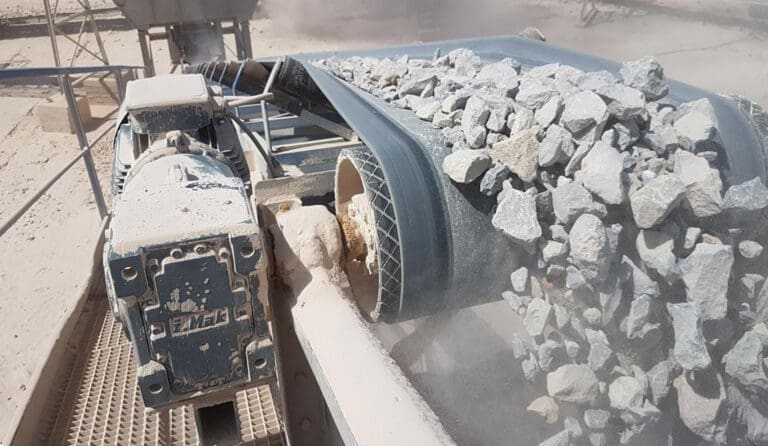
What makes the work hard on a quarry conveyor gearbox
- Inclines: a loaded belt needs high torque to start and will try to run back when it stops.
- Shock loads: falling stone, crusher surges and loaded restarts send peaks through gears and bearings.
- Long hours: many conveyors run two shifts or around the clock.
- Dust and water: abrasive dust, rain, mud and dust suppression spray attack seals, vents and paint.
Step 1: Work out torque, speed and power
Start with the conveyor design: belt speed, drive pulley diameter and effective belt pull (the tension difference either side of the drive pulley).
- Pulley speed (rpm) = belt speed (m/s) × 60 ÷ (π × pulley diameter in m)
- Torque (Nm) = effective belt pull (N) × pulley radius (m)
- Power (kW) = torque (Nm) × pulley speed (rpm) ÷ 9,550
A worked example
These figures are hypothetical. A belt runs at 1.2 m/s over a 500 mm pulley with an effective pull of 14 kN. This gives approximately 45.8 rpm, 3,500 Nm and 16.8 kW at the pulley. A motor running at 1,400 rpm needs an overall reduction of about 30.5:1. Allow for the selected drive’s losses and check starting and thermal duty before choosing a motor rating. Our conveyor torque calculation guide explains these quantities.
Step 2: Choose a service factor
Choose the required service factor from I-MAK’s method for the actual load class, running hours and starts. Do not assume that all quarry conveyors require the same value. If the duty assessment in this example requires a factor of 2.0, the preliminary rating comparison is 3,500 Nm × 2.0 = 7,000 Nm. That is an illustrative assumption, not a factor prescribed for every quarry conveyor.
Check loaded starting torque and acceleration separately against the motor, controls and gearbox’s permitted peak loads. A soft starter or inverter must be selected and configured to meet that duty; fitting one does not make an undersized drive adequate.
Step 3: Choose the quarry conveyor gearbox layout
Shaft mounted: IRO and IRNX
Shaft mounted units (like I-MAK’s IRO and IRNX series) are popular because they fit directly onto the conveyor pulley shaft, with a torque arm to stop the housing turning, so there is no coupling to align. On both ranges, rubber rings work as the torque arm and absorb shock and vibration.
- IRO: I-MAK calls it the best solution for quarries and mining. Rated torque 930 to 7,530 Nm, ratios 5:1 to 30:1, motors up to 160 kW.
- IRNX: 12 sizes from 515 to 42,700 Nm maximum torque, belt driven from motors of 0.37 to 450 kW. I-MAK names belt conveyors and apron feeders among its uses.
In the example, 7,000 Nm falls within the largest IRO sizes and the middle of the IRNX range; we confirm the exact size, including overhung load, against I-MAK’s tables. Our conveyor drives page covers other conveyor types.
Right angle: IRK
Where the motor must sit along the conveyor rather than across it, the IRK helical bevel geared motor is the right angle option, rated from 160 to 18,000 Nm.
Step 4: Stop the belt running back
A loaded belt on an incline will try to run backwards when the drive stops, which can spill material and damage the belt. A backstop lets the drive turn one way only.
- A backstop is an option on the IRO and IRNX; state the free direction of rotation when ordering.
- I-MAK also lists a backstop bearing as a motor option on its geared motors.
- Ask us to confirm the backstop rating for your size.
The backstop, any brake and the conveyor’s system design hold the loaded belt, not the gearing alone. The conveyor must be designed and certified to the relevant standard.
Step 5: Protect against dust, water and corrosion
- Seals and covers: special seal options and an output cover help keep dust out. I-MAK designs the IRO and IRNX housings for easy cleaning and dust resistance.
- Vent plug: keep it clean and shield it where dust is heavy.
- Paint: epoxy, outdoor acrylic and anti-corrosion paints are options; the IRO catalogue gives systems up to category C5 to EN 12944.
- Motors: IP55 as standard, with IP56, IP65 and IP66 options. Confirm the gearbox’s protection and sealing for the exact configuration; the motor IP rating does not apply to the complete drive.
- Hazardous areas: explosion-proof motor options are available, with certification confirmed with I-MAK for the exact unit.
Step 6: Plan lubrication and maintenance
Oil change intervals depend on the range, so follow the operating guide for your unit. For the IRO and IRNX, I-MAK gives a first change after 500 hours, then every 6,000 hours; other ranges, such as the IPR planetary units, use shorter intervals. Running around the clock, 6,000 hours comes round in about eight months.
- Choose the oil grade from I-MAK’s lubricant table; a cold resistant oil rated to minus 40 °C is an option.
- An oil temperature sensor is an option for watching running temperature.
- Check oil level, vent plug and fixing bolts regularly; a blocked vent builds pressure that can push oil past the seals.
Two examples
These are hypothetical, to show the thinking, not reports of real projects.
Example: an inclined limestone conveyor
For a conveyor that runs hot and moves backwards when stopped, investigate the loading, lubrication, thermal duty and existing stopping arrangement. Establish the required service factor and reverse-motion control from that assessment. A backstop, brake or temperature sensor must be selected for its particular function; adding these components is not a diagnosis of the original problem.
Example: a quarry near the coast
Gearboxes on an exposed coastal site are rusting. Replacement IRO units could be specified with a C5 anti-corrosion paint system to EN 12944 and special shaft materials, with a higher motor IP option and regular checks of seals and paint.
Frequently asked questions
Which I-MAK quarry conveyor gearbox should I choose?
For most belt conveyors, a shaft mounted IRO or IRNX. I-MAK calls the IRO the best solution for quarries and mining; the IRNX goes up to 42,700 Nm with a belt input. The IRK is the right angle option.
Is a backstop fitted as standard?
No. On the IRO and IRNX it is an option, ordered with the free direction of rotation.
What service factor should I use?
Use the load class, running hours and starts-per-hour guidance for the selected range. Confirm the actual duty and peak loads rather than adopting a blanket factor of 1.8 or 2.0.
How often should the oil be changed?
It depends on the range, so check the operating guide for your unit. For the IRO and IRNX, I-MAK gives 500 hours for the first change, then every 6,000 hours.
Can you match an existing drive?
Often, yes. Send us the pulley shaft diameter, torque arm arrangement, motor power and speed.
Talk to Advanced Drives
Advanced Drives, based in Silsden, West Yorkshire, is the official UK supplier of I-MAK gearboxes, geared motors and motors. Contact Advanced Drives with your conveyor details and we will help you specify the quarry conveyor gearbox.