

A rotary drill asks a lot of its gearbox. It has to turn the drill string slowly with very high torque, ride out shocks when the bit meets hard rock, carry thrust from the weight on the bit, and keep working in mud, dust and rain. Downtime on a rig is expensive, so a gearbox for rotary drilling needs to be sized properly and easy to look after in the field.
This guide covers the loads involved, why planetary gearboxes suit the job, and what to check when you choose a gearbox for rotary drilling.
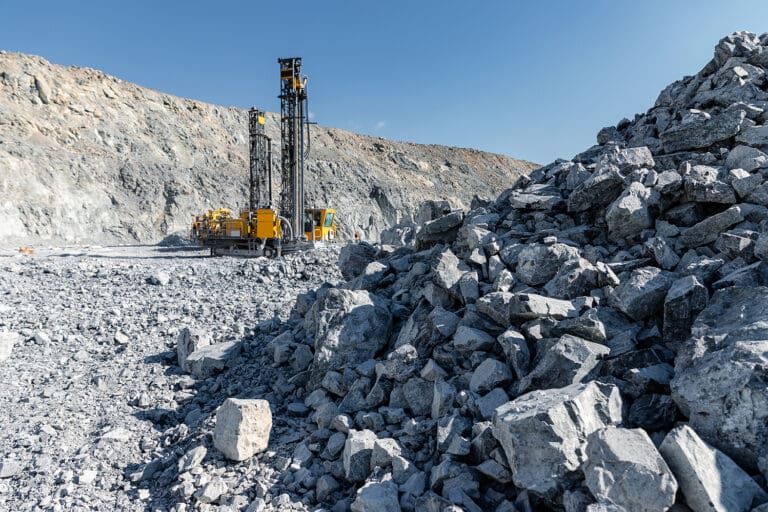
The loads a gearbox for rotary drilling has to carry
High torque at low speed
The drill string turns slowly, but the torque at the bit can be very high, running to hundreds of thousands of Nm on large rigs. That calls for a high reduction ratio and plenty of torque capacity in a compact package.
Shock loads and stalls
Hard layers, voids and a sticking bit can make the torque jump suddenly, or stall the string altogether. The gearbox must be sized for these peaks, not just for normal running torque.
Axial thrust and overhung loads
The weight on the bit pushes and pulls on the output shaft, and a pinion or coupling on the output adds overhung load. The output bearings need to take these loads as well as the torque.
Dirt, water and weather
Drilling sites are wet and dirty. The gearbox needs good sealing and a suitable paint finish, and the motor needs the right enclosure. Around flammable gases, the motor may need to be explosion-proof.
Why a planetary gearbox for rotary drilling makes sense
In a planetary stage, the torque from the central sun gear is shared between several planet gears. This gives high torque in a small, light housing, which matters on a rotary head or top drive. Stages can be stacked to reach the high ratios needed for slow drill rotation.
I-MAK names its IPR and IPRK planetary gearboxes for drilling. The range offers:
- Twenty rated sizes, 101 to 139, with maximum torque (T2max) up to 743,990 Nm on the largest size.
- One to five planetary stages, with ratios on the IPR from 3.55:1 to about 9,793:1.
- Inline (IPR) or right angle with a bevel input stage (IPRK).
- Splined internal connections instead of keys, and self centring planet carriers that share the load evenly between the planet gears.
- Tapered roller output bearings on the M and FV versions, for high axial and overhung loads such as the weight on the bit.
- Keyed, splined, hollow splined and shrink disc outputs, with fittings such as pinions and flanges.
How to size a gearbox for rotary drilling
Gather these details before you choose a size:
- Torque: the normal drilling torque and the peak torque at stall or breakout.
- Speed and ratio: the motor speed and the rotary speed you need at the drill.
- Duty: hours per day, starts per hour and how severe the shocks are. I-MAK’s load classification tables list rotary drilling equipment, which helps set the load class.
- Bearing loads: the axial and overhung loads on the output, which we check against the permitted loads for the chosen size.
- Heat: long drilling runs heat the oil, so compare your duty with the published thermal power.
- Mounting: horizontal or vertical, and the output connection.
Use the right torque figure
I-MAK publishes the output torque for every ratio at four bearing life levels, along with T2max and thermal power, in its catalogues. Pick the column that matches how long the drive must run, and keep a sensible margin. T2max is the peak the gearbox can take, not the figure to size normal running torque against.
Holding the drill string
While new pipe sections are added, the string must stay still. IPR and IPRK gearboxes can be fitted with a negative or modular brake adapter on the input, and I-MAK motors are available with a brake. Brake torques for the adapters are not published, so we confirm the brake size for your holding torque when we quote.
The brake and the rig’s design hold the load, not the gearbox. The rig must be designed and certified to the relevant standards.
Electric or hydraulic motor input
Many drill heads run on hydraulics, while others use electric motors. The planetary range accepts both: IEC motor adapters and electric motors, or adapters for orbit, radial piston and axial piston hydraulic motors. A flexible coupling between motor and gearbox can help cushion shocks.
I-MAK three-phase motors are IP55 as standard, with IP56, IP65 and IP66 options. For oil and gas sites, explosion-proof motor options are available, with certification confirmed with I-MAK for the exact unit.
Maintenance in the field
- Planetary gearboxes are generally supplied without oil, so fill to the correct level for the mounting position before start-up.
- Vertical units, as on many top drives, are filled completely, and an expansion tank is recommended.
- Where the oil stays above 60 °C, I-MAK advises synthetic oil that is compatible with the seals. The oil should never run above 90 °C.
- If the duty exceeds the thermal power, an auxiliary oil cooling system with a heat exchanger can be added.
- I-MAK’s planetary catalogue gives the first oil change after 100 hours, then every 2,000 hours or at least once a year.
- Ask us about seals and paint finish for mud, water and corrosive conditions.
Examples
These examples are hypothetical, to show the selection steps in practice.
Example: a piling rig rotary head
A piling rig needs several hundred thousand Nm at low speed, with heavy shocks in mixed ground, from a hydraulic motor. We would size an IPR gearbox from the larger sizes, at the bearing life column that matches the rig’s duty, with a margin for stall torque. An M or FV output version takes the thrust, and a brake adapter on the input holds the drill still while new sections are added.
Example: a top drive upgrade
An operator wants to replace the gearbox on a vertical electric top drive that runs for long periods. An IPR gearbox would be fitted with an expansion tank, checked against the thermal power, and given auxiliary oil cooling if needed. The motor and its hazardous area certification would be confirmed with I-MAK for that rig.
Frequently asked questions
Which I-MAK gearbox is used for rotary drilling?
The IPR and IPRK planetary range, which I-MAK names for drilling. Its twenty sizes reach 743,990 Nm maximum torque.
Can I use a helical gearbox such as the IR?
The IR is an inline helical range rated 85 to 18,000 Nm, and I-MAK names it for pumps rather than drilling. For drill heads, look at the planetary range.
Can the gearbox hold the drill string still?
A brake adapter can be fitted, and I-MAK motors are available with a brake. The brake and the rig’s design hold the load.
Are explosion-proof motors available?
Yes, as an option. Certification is confirmed with I-MAK for the exact unit.
Talk to us about your drilling drive
Advanced Drives is the official UK supplier of I-MAK gearboxes and motors, based in Silsden, West Yorkshire. Send us your drilling torque, rotary speed, motor type, mounting position and duty, and we will help you choose an IPR or IPRK size. Contact Advanced Drives.