

A winch gearbox must be selected for the required line pull, working drum radius, speed and duty, together with the braking arrangement. Motor power alone does not establish whether a winch can pull, lower or hold its load.
First distinguish the application: pulling a load, lifting a suspended load and handling mooring lines can impose different requirements. This guide explains the information needed for gearbox selection; it is not a design or approval procedure for a complete winch.
Calculate torque at the working drum radius
For a given rope tension, drum torque is line pull in N × working drum radius in m. Use the radius at the relevant rope layer, rather than only the bare drum radius. As rope builds up, the same line pull requires more drum torque; the rope speed also changes at a fixed drum rpm.
Where the load is reeved through multiple rope falls, establish the actual rope tension and losses in the reeving arrangement. Check the required operating cases, including loaded starts, acceleration, stopping and any externally imposed loads. Select the gearbox using the manufacturer’s duty and rating method, rather than a blanket multiplier of 1.5 or 2.0.
Treat braking as part of the complete system
A gearbox transmits torque but does not by itself provide a complete load-holding system. The required brake torque, stopping duty, release control and response to loss of power must be assessed for the winch. The position of a brake in the drive train also affects which components remain in the load-holding path.
A motor flange that accepts a brake motor establishes a mechanical connection, not the suitability of that brake for the winch. Do not remove an existing drum brake merely because a replacement motor has an integral brake. Any change needs assessment by the responsible machine designer.
Backlash can allow limited movement before the opposite tooth flanks engage. Low backlash does not prevent continued movement caused by inadequate braking. Similarly, a backstop restricts rotation in one direction; it is not a substitute for a brake that must control lowering or stopping.
Match the gearbox layout to the drum
- Torque and speed: check continuous and peak ratings at the required ratio and operating speeds.
- Mechanical interface: confirm shafts, splines, flanges, couplings and the support arrangement for the drum and gearbox.
- External loads: establish which bearings carry rope-induced radial or axial loads. Do not assume the gearbox output bearing can support the drum directly.
- Space and access: allow for rope spooling, brake inspection, lubrication and removal of service parts.
- Environment: specify salt spray, water exposure, temperature and any required documentation before ordering.
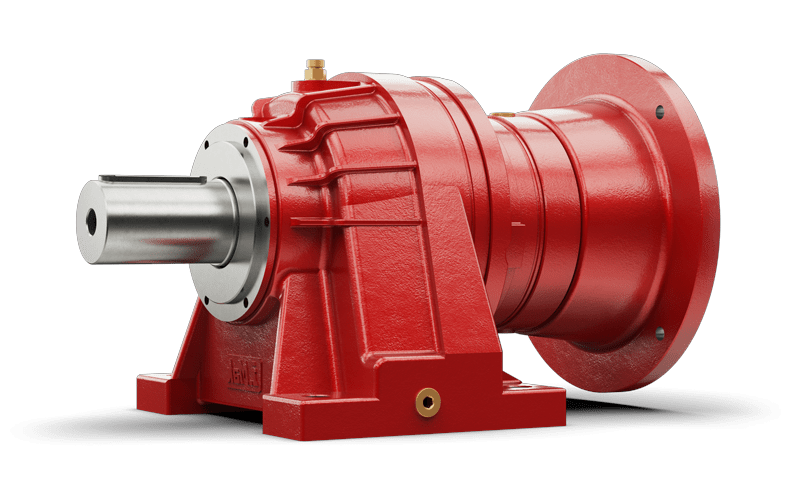
The I-MAK IPR and IPRK planetary ranges provide configurations to assess for winch duties. For hoisting-drum arrangements, the IRC range has dedicated selection information. Neither a range name nor a maximum torque figure establishes suitability for a particular machine.
Illustrative example: reviewing a deck-winch replacement
Suppose a vessel operator wants to replace an ageing winch gearbox. The first step is to record line pull and rope speed across the working drum layers, the operating duty, mounting dimensions and existing brake arrangement. The review should also establish why the original drive needs replacement.
An IPR or IPRK configuration can then be checked against the required ratings and interfaces. Retaining, replacing or relocating a brake is a separate system-design decision. Corrosion protection and any vessel-specific approval requirements must be agreed before supply. This is a selection example, not a reported retrofit or a claim that a brake can be removed.
Information for a winch gearbox enquiry
Send the application, line pull, minimum and maximum working drum diameters, rope speed, reeving details, operating cycles and braking requirements. Include existing nameplates, drawings, supply details and environmental conditions. Contact Advanced Drives to discuss a suitable I-MAK gearbox configuration.
For the wider distinction between drum and travel drives, read our hoist and winch gearbox guide. HSE’s lifting operations guidance explains the need for competent planning and suitable lifting equipment.