

Industrial shredders for scrap metal, plastics, tyres and mixed waste are hard on their drives. The gearbox must turn the cutters slowly with very high torque, take the shock when something hard goes through, and keep doing it shift after shift. An undersized unit means broken teeth, failed bearings and lost production. This guide sets out a practical way to choose a shredder gearbox for your system. Our shredding solutions page shows the machines we support.
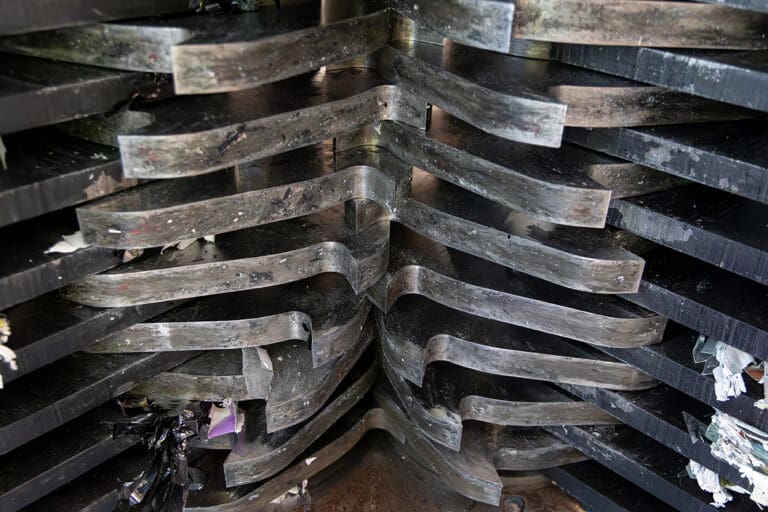
Why shredders are hard on gearboxes
High torque at low speed
Primary shredders often run their cutter shafts at a few tens of rpm or less. Low speed with high power means very high output torque, so the gearbox needs a large ratio and gears, shafts and bearings sized for heavy continuous load.
Shock loads and jams
A buried steel bar or a dense bale can stop the cutters almost instantly. The motor and the rotating inertia then drive into the obstruction, and peak torque can reach several times the running figure. Repeated shocks fatigue teeth and bearings early.
Heat, dust and moisture
Long periods at high load build heat inside the gearbox, and a slow running unit gets little help from natural airflow. Shredding halls are also dusty and often damp, so cooling, sealing and surface protection all matter.
How to size a shredder gearbox
1. Work out the torque at the cutter shaft
Torque (Nm) = 9,550 x power (kW) / shaft speed (rpm)
If the required mechanical power at the shredder shaft is 55 kW at 25 rpm, the corresponding running torque is about 21,000 Nm. If 55 kW instead refers to motor-shaft power, gearbox losses must be included when calculating available output torque. Keep the power measurement point clear. On a twin-shaft machine, establish the load distribution and requirements of each drive.
2. Apply a realistic service factor
Select the service factor from the manufacturer’s method for the material, load class, operating hours and starts. If that assessment requires 2.0, a running torque of 21,000 Nm gives a preliminary rating comparison of 42,000 Nm. The factor is an illustrative assumption, not a universal shredder specification. Check peak loads, thermal capacity and jam protection separately, and apply the factor consistently with the catalogue’s rating basis.
3. Check peak torque
When the cutters stall, a standard induction motor can briefly produce two to three times its rated torque. Multiply that by the ratio and compare it with the gearbox’s maximum permitted torque. If it is higher, add torque limiting or current control rather than relying on the gearbox to absorb it.
4. Check thermal capacity
The gearbox must also shed the heat produced at the power it transmits continuously. If the absorbed power exceeds its thermal rating, it needs a larger size or added cooling.
Choosing the gearbox type
- Helical, parallel shaft: robust and simple, with the motor alongside the machine.
- Bevel helical, right angle: turns the drive through 90 degrees to keep the footprint narrow.
- Planetary: shares the load across several planet gears for very high torque in a compact package, often with a bevel or helical input stage on the largest machines.
The I-MAK ranges we check first
I-MAK lists shredders among its waste treatment applications but does not tie a series to them. We start with its high torque ranges and confirm the selection with I-MAK for each machine:
- MA and MK monobloc gear units: a single piece cast iron housing in nine sizes up to 70,000 Nm, designed for heavy loads on a continuous working cycle. MA is helical with parallel shafts; MK is the bevel helical, right angle version.
- IPR and IPRK planetary gearboxes: designed for high torque in a restricted space, in 20 sizes up to 743,990 Nm maximum torque, inline (IPR) or right angle (IPRK), with electric or hydraulic motor input.
Protecting the drive against jams
- Torque limiting: a mechanical torque limiter, or a drive that monitors motor current, can stop or reverse the cutters before a jam overloads the gearbox. The MA and MK option list includes a torque limiter, confirmed with I-MAK for each size.
- Reversing: many shredders reverse briefly to clear a jam. Select the gearbox for reversing duty, as both tooth flanks take load.
- No backstop: a backstop stops a shaft turning backwards, which a reversing shredder needs to do. Backstops belong on drives such as inclined conveyors.
- Couplings and mounting: a flexible coupling on the input softens shock. For hollow shaft mounting, I-MAK offers a torque arm with a rubber element for MA and MK, and both ranges offer shrink disc connections.
Features worth specifying
- Gears: MA and MK gears are case hardened 16MnCr5 steel, heat treated to 57 HRC and ground.
- Bearings and shafts: MA and MK offer reinforced output bearings and hardened shafts as options; the M and FV versions of IPR and IPRK use tapered roller bearings for high overhung and axial loads.
- Cooling: MA and MK options include fan, radiator, serpentine and heat exchanger cooling, forced lubrication and an oil temperature sensor. IPR and IPRK can have an auxiliary oil cooling system with thermostats.
- Surroundings: MA and MK paint options include epoxy and anti-corrosion finishes. I-MAK motors are IP55 as standard, with IP56, IP65 and IP66 options.
Example: upgrading a twin shaft scrap shredder
This is a hypothetical example. A twin shaft shredder handling scrap metal suffers repeated tooth damage, and one gearbox fails when hardened steel jams the cutters. The original units were sized close to the running torque, with little allowance for shock.
In a case like this, the operator could move to two larger I-MAK MA or MK monobloc gear units, selected with a higher service factor and a flexible coupling on the input, plus torque limiting or reversing control. Where more torque is needed in a compact space, IPR or IPRK planetary gearboxes are the option to discuss. A drive sized this way can process heavier batches without the stoppages a smaller unit would suffer, and is better placed to ride through occasional jams.
Frequently asked questions
What service factor should a shredder gearbox have?
Use the duty and load-class method for the selected range. A generic factor of 2.0 is not a complete selection: starts, material behaviour, peak torque and protective devices also need assessment.
Is a planetary gearbox better for a shredder?
Not always. Planetary units suit very high torque and tight layouts; monobloc helical and bevel helical units suit machines with room for them.
Does I-MAK make a dedicated shredder gearbox?
I-MAK does not name a series for shredders. We look first at MA and MK and at IPR and IPRK, and confirm the selection with I-MAK.
Should a shredder gearbox have a backstop?
Not if the shredder reverses to clear jams, as a backstop would prevent it.
Does a shredder gearbox need extra cooling?
Often. We compare the absorbed power with the thermal rating and add cooling where needed.
Talk to Advanced Drives
A correctly selected shredder gearbox gives the best chance of reliable running in hard conditions. Contact Advanced Drives with the motor power, cutter speed, material and duty cycle, and we will work through the selection with you.