

Shaft-mounted gearboxes fit directly onto the driven shaft through a hollow output shaft. A torque arm restrains the gearbox housing. This can remove the need for a separate output coupling and gearbox base, but the shaft fit, support arrangement and input drive still need to be checked for the machine.
The I-MAK IRO series and IRNX series are shaft-mounted helical gearboxes used in conveying and bulk material handling. A replacement should be selected against its duty and dimensions, rather than assumed to be a universal drop-in fit.
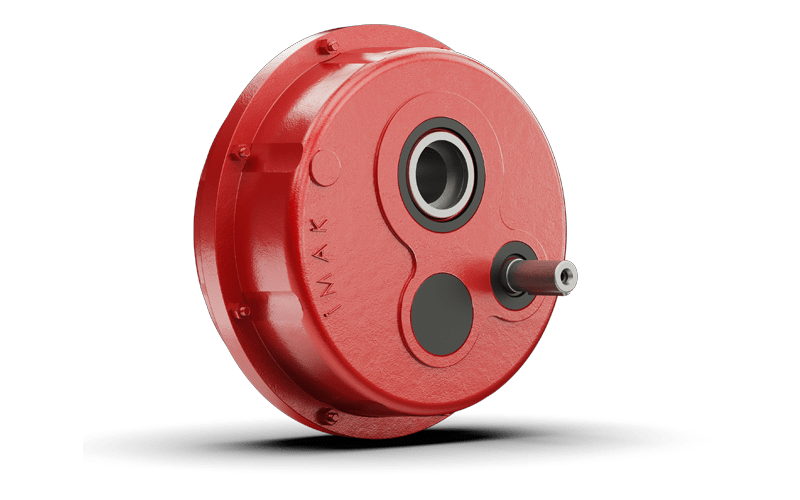
How the shaft-mounted arrangement works
The gearbox’s hollow shaft fits over the machine’s driven shaft, such as a conveyor head pulley shaft. The torque arm connects the housing to a suitable reaction point. This arrangement reduces the number of separate output-drive components, but it does not make alignment, shaft tolerances or structural checks unnecessary.
The input drive must also be selected and installed correctly. For a belt-driven arrangement, pulley alignment, belt tension and the resulting shaft loads need to follow the relevant manufacturer’s requirements. Use the installation instructions for the selected gearbox, mounting position and drive arrangement; this overview is not an installation procedure.
Choosing between shaft, foot and flange mounting
The mounting choice determines how the drive’s weight and reaction forces reach the machine. Available space matters, but so do shaft support, structural stiffness and access when the unit needs removing.
| Arrangement | Main benefit | Checks before selection |
|---|---|---|
| Shaft mounted | Can remove a separate output coupling and gearbox base | Driven-shaft fit and support, assembly weight, torque reaction, input-drive loads and removal access |
| Foot mounted | Supports the gearbox on a dedicated base | Base rigidity, shaft alignment, coupling or transmission loads and guard space |
| Flange mounted | Connects the unit to a machine face in a compact arrangement | Register and bolt pattern, face alignment, structural capacity and the intended bearing arrangement |
A shaft-mounted unit follows the driven shaft, but it is not free from alignment or support checks. The shaft and its bearings must suit the assembly and its forces. Belt-driven inputs still need pulley alignment and correct belt tension. The torque arm must follow the manufacturer’s geometry and restraint arrangement.
A foot-mounted unit may make disconnection and support simpler, particularly where the machine shaft should not carry the gearbox’s weight. The base must remain rigid under load, and a flexible coupling does not remove the need for alignment. An output chain or belt also introduces shaft loads that require checking.
A flange can provide a compact connection, but bolting two faces together does not guarantee that their shafts and bearings form a suitable assembly. Check the register, face runout, fits and structural arrangement against the approved drawings.
Before changing mounting type on an existing machine, compare the support loads, connection details, lubrication orientation and maintenance envelope. A layout that fits neatly may still be difficult to remove or inspect.
Send Advanced Drives a drawing or photographs of the existing support arrangement, shaft details, required torque and speed, assembly weight limits and available service space. This allows the mounting choice to be assessed alongside the gearbox selection.
Comparing I-MAK IRO and IRNX gearboxes
| Range | Published maximum output torque | Range information |
|---|---|---|
| IRO | Up to 7,530 Nm | IRO specifications, sizes and downloads |
| IRNX | Up to 42,700 Nm | IRNX specifications, sizes and downloads |
These figures describe the top of each range, not the torque available from every size at every speed. The required ratio, operating speed, service factor, shaft dimensions and available space determine the appropriate unit. The IRNX catalogue includes performance tables for different belt-pulley ratios, so the complete motor and pulley arrangement matters.
A backstop is an option for applications such as an inclined conveyor where reverse movement must be prevented. Confirm the required direction of rotation and the suitability of the backstop for the duty. Its presence does not by itself establish that the complete machine meets its safety requirements.
What to check before selecting or replacing a gearbox
- Load and duty: the required output torque, starting load, starts per hour and daily operating hours.
- Speed: the motor speed, gearbox ratio, any belt ratio and the required driven-shaft speed.
- Mechanical fit: shaft diameter and tolerances, key arrangement, available shaft length, mounting clearances and torque-arm attachment.
- Operating conditions: mounting position, lubrication, temperature, contamination and access for inspection.
- Stopping and reverse movement: the required rotation direction, backstop or braking arrangements and the machine’s safety requirements.
For an existing drive, send photographs of the nameplate, shaft connection, input drive and torque arm. Include the machine’s duty and any drawings or dimensional measurements. This helps establish compatibility before a replacement is ordered.
Applications and maintenance
Typical applications include belt, bucket and screw conveyors, apron feeders and grain handling. Selection still needs to account for the particular material, loading pattern and operating conditions. The I-MAK IRNX product information lists these applications.
Direct mounting reduces the number of separate components, but does not remove maintenance requirements. Follow the manufacturer’s inspection and lubrication instructions for the selected unit. Check the shaft fixing, torque arm, seals and input-drive components as applicable, and investigate unusual noise, vibration or temperature.
Illustrative example: assessing a gravel-conveyor retrofit
For a gravel conveyor being converted to a new motor drive, start with the loaded starting torque, required belt speed and operating hours. Then check the head-pulley shaft dimensions, space for the input drive and a suitable torque-arm reaction point. An inclined conveyor also requires assessment of reverse movement and stopping arrangements.
Those checks establish whether an IRO, IRNX or another arrangement is suitable. This is a selection example, not a reported customer installation or a promise of fitting time or performance.
Discuss your shaft-mounted drive
Contact Advanced Drives with the nameplate details, dimensions and duty. We can help assess an I-MAK gearbox for a new application or replacement.
Related guidance
- Understanding Gearbox Mounting Positions for Material Handling – A Practical Guide
- Replacing an Industrial Gearbox: Dimensional Checks Before You Order
Contact Advanced Drives about your application.
Technical references
Technical reference: I-MAK IRNX catalogue. Use the current documentation for the exact unit selected.