

When a machine needs a slow output speed from a standard motor, a worm gearbox is often the simplest answer. One compact stage gives a high reduction and a right angle output. This guide explains how worm gearboxes work, what they can and cannot do when a load must be held, and how the I-MAK S, IRS and IRSD ranges compare.
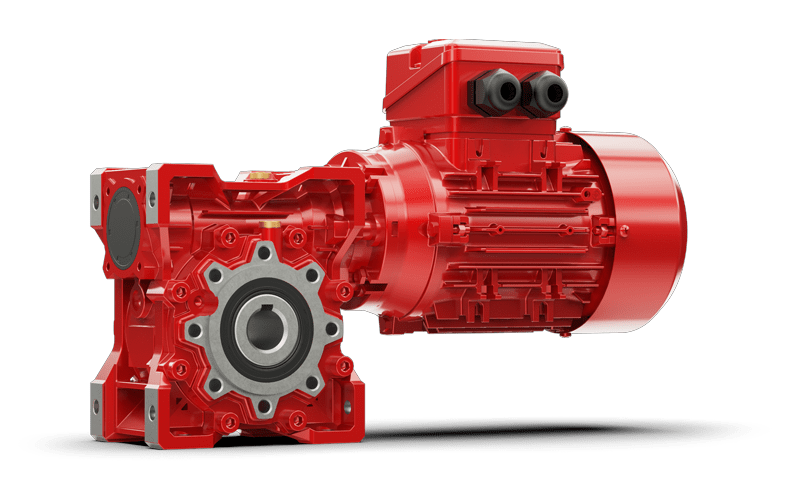
How a worm gearbox works
The motor drives the worm, a threaded shaft, which meshes at 90 degrees with the worm wheel on the output shaft. Each turn of the worm moves the wheel on by one tooth, or by more on a worm with several starts, so ratios that would need several helical stages come from a single stage.
The teeth slide rather than roll, which means:
- Efficiency is lower than helical gearing, and falls as the ratio rises.
- More input power becomes heat, so thermal capacity matters on long duty cycles.
- Running is smooth and quiet, and the design is simple.
Back-driving and holding a load
Some worm gear sets, mainly at high ratios, resist being turned from the output. This is often called self-locking, but it cannot be relied on. Whether a worm drive back-drives depends on the ratio, lubricant, temperature, wear and vibration, so a drive that holds when cold and still may creep or run back when warm or vibrating. I-MAK makes no self-locking claim for its S, IRS or IRSD ranges.
Brakes and backstops have different functions
Specify load holding as part of the complete machine. A brake can be selected for stopping and holding duties; a backstop restricts rotation in one direction and does not provide controlled lowering. Confirm the required functions and the options available for the selected I-MAK unit:
- A brake motor, including hand release (BRH) and double brake (BD or BDH) versions.
- A backstop (option BS), fitted at the motor side, which stops the output turning backwards, for example on an inclined conveyor.
For lifts, hoists, winches and any other load holding duty, the complete machine must be designed and certified to the relevant standard.
The I-MAK worm ranges
All three ranges have a hollow output shaft as standard, with solid output shafts, output flanges and torque arms as options. Torques below are rated at 1,400 rpm input.
S Series: compact worm gearboxes
The S Series comes in nine sizes, S 30 to S 150, rated from 13 Nm to 1,554 Nm, with geared motors from 0.12 kW to 15 kW. Single units give ratios from 7.5:1 to 100:1, and two S units combined reach 5,000:1. Compact and light, the S suits lighter duties, and sizes S 30 to S 90 take the same small oil volume in every mounting position.
IRS Series: cast iron worm gearboxes
The IRS Series has a cast iron housing and eight sizes, IRS 52 to IRS 250, rated from 152 Nm to 10,562 Nm, with geared motors from 0.25 kW to 22 kW and ratios from 7.25:1 to 115:1. Combinations with an S, IRS or I-MAK IR helical first stage reach 5,000:1. I-MAK positions the IRS for simple applications that need high ratios, and for duties where the backstop needs to be strong.
IRSD Series: helical worm gearboxes
The IRSD Series adds a helical stage ahead of the worm in one cast iron housing. Its six sizes, IRSD 43 to IRSD 103, are rated from 197 Nm to 6,000 Nm, with geared motors from 0.12 kW to 18.5 kW and ratios from 15:1 to 499:1. I-MAK states that it runs more quietly and more efficiently than a simple worm unit. A shrink disc and a hardened hollow shaft are options only on the IRSD.
Where worm gearboxes fit
Worm gearboxes suit steady, low speed drives where a compact right angle unit helps. I-MAK’s selection tables for its worm ranges include:
- Conveyors, screw conveyors and bucket elevators, with the backstop option on inclines. See our conveyor drive solutions.
- Mixers, agitators and pumps.
- Filling, packaging and kneading machines. A food compatible oil is an option, and I-MAK asks to be told when a unit will be used in food processing so it can be adapted.
- Goods lifts, always with a brake motor.
Worm drives also turn rotary tables and indexers, where a brake motor and the controls hold each stop.
Selection and care
- Sizing: start from the output torque and speed, then apply a service factor for the load type, running hours and starts per hour. Check heat on long, high ratio duties and shaft loads from chains or belts.
- Mounting: on the larger S sizes and on every IRS and IRSD size, the oil quantity depends on the mounting position, so tell us the position when you order.
- Lubrication: use the oil given on the nameplate and in the I-MAK manual. I-MAK’s guidance is to check the oil level, vent plug and fixing bolts, and to change the oil after the first 500 hours, then every 6,000 hours.
- Motors: standard motors suit 0 °C to 40 °C ambient and are rated IP55, with IP56, IP65 and IP66 as options.
Example: a sliding gate drive
This is a hypothetical example to show the selection approach, not a real installation.
A warehouse needs a slow security-gate drive in a tight space. An S Series unit could be assessed against the required gate force, speed, travel, starts per hour and shaft arrangement. The motor and any brake must be selected from those requirements, rather than an assumed power rating. The complete powered-gate design also needs suitable controls and protective measures; this example does not establish that a particular gearbox or brake is sufficient.
Frequently asked questions
Are I-MAK worm gearboxes self-locking?
Do not rely on the worm gearing as a load-holding safety function. Back-driving behaviour depends on the arrangement and operating conditions. Select a suitable braking system where stopping or holding is required; use a backstop only for the reverse-motion duty for which it is specified.
What is the difference between the S, IRS and IRSD?
The S is the compact range, rated up to 1,554 Nm. The IRS has a cast iron housing and is rated up to 10,562 Nm. The IRSD adds a helical stage for ratios up to 499:1 in one housing.
When should I choose a helical worm unit?
Choose the IRSD when you need a very low output speed from one unit, or quieter, more efficient running than a simple worm unit.
How often should the oil be changed?
I-MAK’s guidance is after the first 500 hours, then every 6,000 hours, with regular oil level checks. Use the oil given on the nameplate.
Can a worm gearbox be fitted in any position?
There are many foot and flange positions, but the oil quantity must be set for the position used, so tell us the position when you order.
Talk to Advanced Drives
Advanced Drives is the official UK supplier of I-MAK gearboxes, geared motors and motors, based in Silsden, West Yorkshire. Tell us the torque, speed, duty and mounting position you need and we will help you choose between the S, IRS and IRSD. Contact us to discuss your application.